 Following an ex officio investigation into a potential infringement of competition law, initiated on April 4, 2024, against Metabo Centar Kragujevac and KAPRO INDUSTRIES LTD, Israel, the Commission determined that the aforementioned undertakings entered into a restrictive agreement with the objective of substantially restricting, distorting, and preventing competition, as set forth under Article 10. Consequently, the Commission has adopted appropriate measures to safeguard competition.
The proceedings were initiated upon receipt of information indicating that Metabo Centar Kragujevac, acting as the importer of mechanical and laser measuring instruments manufactured by Kapro, exerted pressure—through the manufacturer KAPRO INDUSTRIES LTD of Israel—on suppliers of Kapro-branded tools who serve other market participants in the Republic of Serbia, compelling them to discontinue their deliveries. This conduct effectively resulted in the elimination of competition within the wholesale market for these tools.
Based on the aforesaid, the Commission has reasonably concluded that Metabo Centar and Kapro Israel engaged in practices aimed at, or having the effect of, eliminating competition against Metabo Centar in the wholesale distribution of Kapro-branded tools within the Republic of Serbia. This conduct resulted in a significant reduction of market alternatives, compelling purchasers to pay inflated prices for these tools compared to what would have been possible had multiple distributors been available.
It was further determined that the agreements entered into by Metabo Centar Kragujevac with its customers contained clauses prohibiting the resale of Kapro-branded tools below their purchase price. Such restrictions may function as a mechanism to hinder imports, thereby preserving the pricing of Kapro tools at a controlled level. Furthermore, this practice constitutes an independent infringement of competition law through the imposition of minimum resale prices.
 Representatives of the Commission for the Protection of Competition participated in a consultation held in Belgrade, organized by the Association of Corporate Lawyers in cooperation with the Chamber of Commerce and Industry of Serbia (PKS).
The topic was “Business Compliance with Competition Protection Regulations,” during which members of the association discussed the legal framework, the objectives of competition protection rules, the institutional setup, and the jurisdiction of the Commission for the Protection of Competition. The discussion also covered specific competition-related risks that should be identified and avoided in the compliance process, the importance of ensuring compliance, and the guidelines for developing compliance programs with competition protection regulations — introduced by the Commission at the end of 2021.
This consultation is part of the Commission’s ongoing efforts to raise awareness among market participants about the need for and methods of achieving compliance with competition protection regulations.
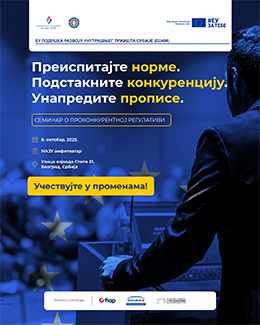 On October 8, 2025, the National Academy for Public Administration in Belgrade hosted a seminar dedicated to pro-competitive regulation.
With Serbia’s regulatory landscape constantly evolving, the demand for clear and effective pro-competitive policies is growing. Experts from the European Union led the event, sharing insights on how to improve current regulations and develop new ones that foster market competitiveness and encourage fair competition. Key topics covered during the seminar included:
Identifying regulatory obstacles that hinder competition
Enhancing collaboration between regulatory and supervisory bodies and legislative institutions
Promoting a more competitive Serbian market through regulations that protect consumers, safeguard the market, and strengthen the economy
This event was held within the framework of the “EU Support for the Development of Serbia’s Internal Market” (EU4IM) project, which aims to reinforce Serbian institutions and harmonize domestic legislation with EU market standards. The project is being implemented by FIAP from Spain, in partnership with the Slovak Development Agency for Cooperation (AICS).