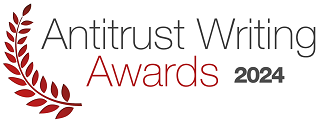
 The Commission’s guidelines for drafting compliance programs, with the accompanying model and compliance checklists, won this year’s Antitrust Writing Awards readers vote award in the section of the best “Soft Law” materials of competition authorities (Soft Laws & Studies – Best ” soft laws” and studies) in the region of Europe. The full name of the award is “Best Soft Law, Europe, Readers Choice – 2024 Antitrust Writing Awards”.
These prestigious awards are organized by the publication Concurrences and George Washington University, and the goal is to promote the study of competition law and contribute to the promotion and advocacy of competition protection (antitrust advocacy) in the spheres of law and economics.
The Commission’s publication is one of the eight awarded “Soft Law” materials of competition authorities, and in addition to the Commission’s guidelines, the works of the European Commission and the competition protection bodies of the United Kingdom, France, Austria, Hungary, Portugal, Spain, the Netherlands, Lithuania and Turkey, were eligible for votes in the category “Europe”.
The selection of the Best “soft laws” and studies aims to contribute to the development of the culture and awareness of competition protection. This category seeks to support the international promotion and advocacy of competition protection (antitrust advocacy) by highlighting the most expedient and relevant materials of competition protection bodies that do not refer to specific subjects and procedures, such as guidelines, market analyses, etc. It aims to single out some of the most interesting administrative practices that could be applied more often and more widely.
 The Commission, based on publicly available data, has been notified on the intent of all three mobile operators to increase the prices of their services. However, based on this fact alone it cannot be concluded it is a behavior that is potentially contrary to the Law on Protection of Competition.
As in all other cases, in this specific case, in order for the Commission to determine it is a prohibited behavior, legal procedure must be implemented beforehand to determine the existence of antitrust infringements. The purpose of procedure implementation is to collect facts that could prove the violation of the Law on Protection of Competition.
However, considering there is a formal, legally prescribed standard for initiation of procedure in front of the Commission, which is the well-founded presumption antitrust infringement has occurred, it is necessary to determine the merits of statements and review the facts beforehand. In case it is subsequently concluded there is a reasonable doubt that detected behavior is the result of illegal action, the Commission shall initiate the procedure of reviewing antitrust infringement.
Since, in line with the Law on Protection of Competition, the Commission has different mechanisms available to collect the necessary facts, the Commission shall not announce its possible intention to act in specific cases.
 The Commission for the Protection of Competition and the National Competition Commission of Paraguay (CONACOM – Comisión Nacional de la Competencia) held a joint online session where representatives of the Commission presented the working method related to the independent detection of cartels without relying on the leniency program,notifications or cooperation with other authorities.
Officials and representatives of the Paraguayan authorities were explained the cartel detection method developed by the Commission and were familiarized with its practice regarding the detection and proof of concerted practices as a type of restrictive agreement.
The collaboration took place during the 22nd annual conference “Global Competition Forum” Organization for Economic Cooperation and Development (OECD) held in Paris, where CONACOM officials expressed interest in the method presented by the Commission for the Protection of Competition.
A member of the Council of the National Competition Commission of Paraguay, Eduardo Barros, expressed his gratitude to the Commission for the presentation held to CONACOM employees.
Commission for Protection of Competition determined that companies KTG Solucije and Eco Sense Subotica with seat in Subotica agreed on the terms of participating in several public procurements procedures that were related to the procurement of cleaning products, thus concluding a restrictive agreement.
The Commission, through the Public Procurement Office, learned that KTG Solucije, as the bidder in certain public procurement procedures withdrew from the bids, thereby the contracting parties concluded the agreements with second-ranked bidder, Eco Sense, but, with higher prices compared to the ones offered by KTG Solucije. The subject of disputable public disputes were materials and products for cleaning buildings.
In addition to information on withdrawal from bids, the Commission, through the analysis of IP addresses (Internet Protocol Address) from which KTG Solucije d.o.o. and Eco Sense d.o.o. accessed the Public Procurement Portal in the said public procurement procedures, whether to download tender documents or submit bids, concluded that both companies almost always accessed from identical IP addresses. Results of IP address analysis point to the fact that both companies accessed the Public Procurement Portal almost always from devices that were connected on the same internet network, possibly from the same device.
Protection competition measures were imposed to the participants in a restrictive agreement, which was reduced for KTG Solucije due to the fact it used the “leniency program”, in line with Article 69 of the Law. The significance of this case is that this is the first case in which the Commission determined fulfilment of conditions to reduce the obligation of monetary amount payment related to competition protection measure based on the notification of the participant in restrictive agreement submitted during the procedure, that is, after it has been initiated.
 The Commission for Protection of Competition’s Guidelines for Drafting Competition Compliance Programs, with the Template Competition Compliance Program accompanying the Guidelines and two Competition Checklists for assessing exposure of undertakings to risks of competition infringements, have been nominated this year for the Antitrust Writing Awards, organized by Concurrences and George Washington University. The aim of the Antitrust Writing Awards is to promote competition scholarship and contribute to competition advocacy in the legal and economic fields.
The publication in English is nominated in the section of the best Soft Laws & Studies of competition authorities in the subcategory “Europe”. The Commission is in the same category with the European Commission and competition authorities of the UK, France, Austria, Hungary, Portugal, Spain, the Netherlands, Lithuania and Turkey.
The “Best Soft Laws & Studies” selection aims to contribute to developing antitrust culture and awareness. It seeks to support international antitrust advocacy by drawing attention to the most meaningful non-enforcement documents published by competition agencies such as guidelines, market studies, etc. It aims at singling out some of the most interesting administration practices that could be usefully applied more generally.
As in previous years, the nominations are evaluated by a jury composed of leading antitrust enforcers, academics, and counsel and at the same time there is an audience vote.