

Press Releases « Commission for Protection of Competition
Home » News » Press Releases
Law on Trade Practices for Certain Types of Products Comes into Force

kzk Upon entry into force of the Law on Trade Practices for Certain Types of Products (Official Gazette of the Republic of Serbia No. 35) on 1 May 2026, the Commission for Protection of Competition, as an autonomous and independent authority, shall also exercise the public powers in accordance with this Law, in addition to the competences conferred to it under the Law on Protection of Competition (Official Gazette of the Republic of Serbia Nos. 51/2009, 95/2013 and 35/2026 – other law).

The main objective of the Law on Trade Practices for Certain Types of Products is to ensure fair, transparent, and predictable business relations within the supply chain of agricultural and food products, as well as products of strategic importance for market supply, through the prevention, detection, and sanctioning of unfair trade practices.

Application:

This Law shall apply directly to relations between suppliers and buyers engaged in trade within the territory of the Republic of Serbia, namely:
1) agricultural and food products;
2) products of particular importance for market supply — for consumer supply, including household chemical products, paper and kitchen goods, personal hygiene and cosmetic products, and diapers; and for agricultural production, including plant nutrition and protection products, as well as soil improvers.

This Law shall apply directly to commercial relations between professional suppliers and buyers within the territory of the Republic of Serbia, with a clearly defined subject-matter scope. By its nature, this Law shall not apply to relations with consumers (B2C), but shall be exclusively directed at regulating business-to-business (B2B) relations between professional undertakings.

In such context, the term “supplier” shall refer to any agricultural producer, whether a natural or legal person, including their organisations or associations, who sells agricultural and food products, as well as any producer, importer, or distributor of products of particular importance for market supply.

On the other hand, the term ‘buyer’ shall refer to any legal entity or entrepreneur that, in the course of its business activities, purchases such products for further sale, processing, or distribution.

Deadlines:

Each entity in the supply chain of products covered by this Law shall be required to bring its general business terms and conditions, contracts, internal guidelines and practices into compliance with the provisions of this Law within four months from the date of its entry into force.

The by-laws required for the implementation of this Law shall be adopted within 30 days from its entry into force.
Government Adopts Four New Regulations

kzk At its session of 19 March 2026, the Government adopted four new regulations governing the exemption of certain agreements from the prohibition of restrictive agreements, namely:

- Regulation on categories of vertical agreements exempted from the prohibition of restrictive agreements;
– Regulation on categories of vertical agreements in the motor vehicle sector exempted from the prohibition of restrictive agreements;
- Regulation on categories of technology transfer agreements exempted from the prohibition of restrictive agreements;
- Regulation on categories of agreements in the railway and road transport sector exempted from the prohibition of restrictive agreements.

These Regulations entered into force on 28 March 2026.

Upon the entry into force of the Regulation on categories of vertical agreements exempted from the prohibition of restrictive agreements, the Regulation on agreements between undertakings operating at different levels of production or distribution exempted from the prohibition (“Official Gazette of the Republic of Serbia”, No. 11/10) ceased to apply.

The transitional provisions of the Regulation on categories of vertical agreements exempted from the prohibition of restrictive agreements provide that: “Exemption from the prohibition of vertical agreements concluded prior to the entry into force of this Regulation, which fulfilled the conditions prescribed by the Regulation on agreements between undertakings operating at different levels of production or distribution exempted from the prohibition (“Official Gazette of the Republic of Serbia”, No. 11/10), but which do not meet the conditions prescribed by this Regulation, shall apply for six months from the date of entry into force of this Regulation.”

Vertical agreements concluded prior to the date of entry into force of this Regulation shall be aligned with the provisions of this Regulation within six months from the date of its entry into force.”

Competition Infringement Established and Competition Protection Measure Imposed on Vaillant d.o.o., Belgrade

kzkIn ex officio proceedings concerning an alleged infringement of competition law by Vaillant d.o.o., Belgrade, the Commission for Protection of Competition found that the company had concluded restrictive agreements having as their object the significant restriction, distortion and prevention of competition within the meaning of Article 10 of the Law on Protection of Competition. Accordingly, the Commission imposed a competition protection measure amounting to RSD 15,569,280.00.

On 19 January 2023, the Commission for Protection of Competition opened ex officio infringement proceedings against Vaillant d.o.o., Belgrade, a distributor of heating equipment under the “Vaillant” and “Protherm” brands, on the basis of a reasonable suspicion that the undertaking had imposed resale prices for those products in the Republic of Serbia, thereby engaging in resale price maintenance (RPM). The Commission also carried out a dawn raid at the undertaking’s business premises.

Prior to initiating the proceedings, the Commission compared the wholesale and retail prices from the price list of Vaillant with the retail prices displayed on the websites of certain authorized distributors and determined that they are identical, both among all of the observed retailers, and against the prices from the price list available on the website of Vaillant. Moreover, based on the available data, the company Vaillant is not present on the retail market of products of the “Vaillant” and “Protherm” brands, but only through its distributors.

The Commission found that, since 2017, Vaillant had operated a business model based on the wholesale distribution of Vaillant and Protherm branded products to its distributors under identical or substantially similar terms and conditions. The distributors were periodically supplied with identical price lists specifying wholesale and retail prices, which they were expected to implement and pass on to their downstream customers throughout the distribution network. In addition, they received a rebate policy prescribing the discount structure to be adhered to by the distributors and all other members of the distribution network. Under the rebate policy, discount rates differed depending on the product type, the brand in question, and the customer segment. The evidence showed that Vaillant actively enforced and monitored the consistent application of prices for Vaillant and Protherm products. Vaillant concluded separate agreements with retailers and installers in its distribution network for alleged market-development services. Pursuant to those agreements, it provided financial incentives once the recipients submitted invoices from which the resale prices of the products could be ascertained. Conversely, Vaillant refrained from paying incentives that traders had come to expect in cases where they deviated from its pricing policy, even where the agreed sales volumes had been met, thereby rendering the withholding of such incentives a punitive measure.

The core of this type of infringement is that a supplier of a product restricts its buyer (and/or other buyers within the distribution network, including retailers) from independently and freely setting resale prices in downstream sales. This substantially restricts competition between retailers of the same brand, removes the possibility of retail price competition, and thereby prevents price reductions at the retail level, to the detriment of consumers.

Commission Concludes Proceedings and Imposes Measures on Metabo Centar and Kapro Industries LTD

kzkFollowing an ex officio investigation into a potential infringement of competition law, initiated on April 4, 2024, against Metabo Centar Kragujevac and KAPRO INDUSTRIES LTD, Israel, the Commission determined that the aforementioned undertakings entered into a restrictive agreement with the objective of substantially restricting, distorting, and preventing competition, as set forth under Article 10. Consequently, the Commission has adopted appropriate measures to safeguard competition.

The proceedings were initiated upon receipt of information indicating that Metabo Centar Kragujevac, acting as the importer of mechanical and laser measuring instruments manufactured by Kapro, exerted pressure—through the manufacturer KAPRO INDUSTRIES LTD of Israel—on suppliers of Kapro-branded tools who serve other market participants in the Republic of Serbia, compelling them to discontinue their deliveries. This conduct effectively resulted in the elimination of competition within the wholesale market for these tools.

Based on the aforesaid, the Commission has reasonably concluded that Metabo Centar and Kapro Israel engaged in practices aimed at, or having the effect of, eliminating competition against Metabo Centar in the wholesale distribution of Kapro-branded tools within the Republic of Serbia. This conduct resulted in a significant reduction of market alternatives, compelling purchasers to pay inflated prices for these tools compared to what would have been possible had multiple distributors been available.

It was further determined that the agreements entered into by Metabo Centar Kragujevac with its customers contained clauses prohibiting the resale of Kapro-branded tools below their purchase price. Such restrictions may function as a mechanism to hinder imports, thereby preserving the pricing of Kapro tools at a controlled level. Furthermore, this practice constitutes an independent infringement of competition law through the imposition of minimum resale prices.

Seminar on Pro-Competitive Regulation

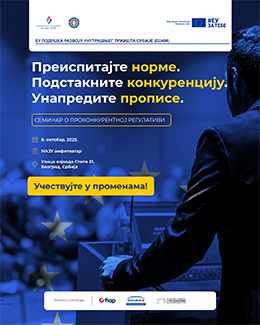
kzk-ekofOn October 8, 2025, the National Academy for Public Administration in Belgrade hosted a seminar dedicated to pro-competitive regulation.

With Serbia’s regulatory landscape constantly evolving, the demand for clear and effective pro-competitive policies is growing. Experts from the European Union led the event, sharing insights on how to improve current regulations and develop new ones that foster market competitiveness and encourage fair competition. Key topics covered during the seminar included:

Identifying regulatory obstacles that hinder competition
Enhancing collaboration between regulatory and supervisory bodies and legislative institutions
Promoting a more competitive Serbian market through regulations that protect consumers, safeguard the market, and strengthen the economy
This event was held within the framework of the “EU Support for the Development of Serbia’s Internal Market” (EU4IM) project, which aims to reinforce Serbian institutions and harmonize domestic legislation with EU market standards. The project is being implemented by FIAP from Spain, in partnership with the Slovak Development Agency for Cooperation (AICS).

NOTICE – CHANGE OF ADDRESS OF THE COMMISSION FOR PROTECTION OF COMPETITION

We hereby inform all interested parties that, pursuant to the Decision of the City Assembly of Belgrade on the renaming of Savska Street to Bulevar Kralja Aleksandra I Karađorđevića, the new address for the submission and receipt of mail to the Commission for Protection of Competition is:

Commission for Protection of Competition
Bulevar Kralja Aleksandra I Karađorđevića No. 25/IV
11000 Belgrade

All other contact information and procedural details remain valid and unchanged.

Commission Submits Proposals for Four New Regulations for Adoption

kzkAfter obtaining the necessary opinions and completing the legal and technical review, the Commission for Protection of Competition has submitted to the Government of the Republic of Serbia four new regulations for adoption, addressing the exemption of agreements from prohibition:

- Proposal for a Regulation on Categories of Vertical Agreements Exempted from the Prohibition of Restrictive Agreements
- Proposal for a Regulation on Categories of Vertical Agreements in the Motor Vehicle Sector Exempted from the Prohibition of Restrictive Agreements
- Proposal for a Regulation on Categories of Technology Transfer Agreements Exempted from the Prohibition of Restrictive Agreements
- Proposal for a Regulation on Categories of Agreements in the Railway and Road Transport Sector Exempted from the Prohibition of Restrictive Agreements

Sectoral Analysis of the Pharmaceutical Market

kzkThe Commission for Protection of Competition will carry out a sectoral analysis of the state and conditions of competition in the pharmaceutical market for human medicine in the Republic of Serbia.

The analysis will focus on the market for pharmaceuticals used in human medicine, with particular emphasis on drugs included in the official list prescribed and dispensed at the expense of mandatory health insurance funds. Additionally, the study will address pricing mechanisms, market shares, competitive conditions, potential barriers to market entry, vertical relations between wholesalers and pharmacies, and other related aspects.

The main objective is to identify potential measures and activities that the Commission, through opinions and proposals/recommendations, will submit to the relevant authorities and market participants, with the aim of enhancing the competitive conditions in this market.

At present, questionnaires are being distributed to pharmacy establishments with multiple retail outlets to gather the data required for the analysis.

PROCEEDINGS INITIATED AGAINST FOUR RETAIL CHAINS

kzkOn October 10, 2024, the Commission for Protection of Competition initiated proceedings against DELHAIZE SERBIA DOO,PRIVREDNO DRUŠTVO ZA POSLOVNE USLUGE MERCATOR-S DOO BELGRADE, UNIVEREXPORT EXPORT-IMPORT DOO NOVI SAD, and PROIZVODNO I TRGOVINSKO PREDUZEĆE DIS DOO KRNJEVO, and conducted dawn raids at their premises. Dawn raids were also simultaneously conducted at the business premises of Cenoteka, as a third party. The proceedings were initiated based on the Commission’s reasonable assumption that the said retail chains committed competition infringement by entering into a restrictive agreement as defined in Article 10 of the Law on Protection of Competition.

Namely, the Commission is carrying out a Sectoral Analysis of the state and competitive conditions in the markets for certain food products within the Republic of Serbia, covering the period from 2018 to 2022. In light of certain findings that underscored the need for further in-depth analysis, the Commission expanded its examination to assess the competitive conditions in the retail market for a wider range of food products.

A comprehensive analysis was carried out by tracking selected products from the retailers currently facing proceedings. Publicly available data from financial reports released by the Serbian Business Registers Agency indicate that these retailers collectively represent more than 50% of the retail market in the Republic of Serbia.

Thus, the Commission, over several months of monitoring price movements for 35 selected products, found that the prices for the observed products were identical across the retail chains.
Subsequently, in August 2024, the Commission compared prices for 45 products among the parties involved in the proceedings, including an additional retailer.

Based on all of the conducted analyses, the Commission was able to draw the following conclusions:

• the retail market in Serbia saw a value growth in the period from April 2023 to March 2024, while simultaneously experiencing a modest decrease in volume.
• in the period from April 2023 to March 2024, the increase in retail prices was nearly twice as high as inflationary pressures.
• in the period from 2016 to 2023, a substantial increase in revenue and gross margins was observed among the market participants under review, which is further substantiated by data regarding their operating profit.
• throughout the multi-month monitoring period from April to September 2024, the regular prices of eight products (milk, yogurt, oil, flour, sugar, eggs, coffee, and bananas) among all observed retailers were found to be either identical or similar, despite differing procurement conditions.
• the value of the consumer basket containing 45 selected products shows only slight variations among the parties involved in the proceedings, while being significantly lower at the retail establishment with the least favorable procurement conditions.

Based on the comprehensive findings, the Commission reasonably inferred that the indicators observed in the retail market resulted from a lack of competitive pressure among the examined retailers, indicating that these entities may have entered into a restrictive agreement as stipulated in Article 10 of the Law. This conclusion is particularly supported by the fact that the only form of competition for the observed products is price competition, which is entirely absent under conditions of identical regular and promotional prices.

The Commission takes this opportunity to emphasize that, in its work—especially in proving tacit, prohibited agreements—it has access to various mechanisms that require a certain degree of confidentiality. Consequently, the Commission is unable to publicly announce its potential intentions concerning actions in specific cases to preserve the integrity of the proceedings. For the same reason, the Commission refrains from commenting on media appearances or statements made by individuals or organizations, whether accurate or inaccurate, to avoid sending a “signal” to market participants that could jeopardize the proceedings before the Commission.

All individuals possessing data, documents, or other relevant information that may be pertinent to establishing the factual circumstances in the aforementioned proceedings are kindly invited to submit such information to the Commission for Protection of Competition, located at 25 Savska Street, Belgrade.

Representatives of the Commission on Study Visit to the Danish Competition Authority

kzk-ekofRepresentatives of the Commission for Protection of Competition conducted a study visit to the Danish Competition and Consumer Authority (DCAA) and other institutions within the Danish public procurement system. The visit took place within the framework of the “Public Procurement Improvement Project,” which is funded by the United States Agency for International Development (USAID) and organized by NALED. Alongside the representatives of the Commission, representatives from the Public Procurement Office and the project were also involved.

One of the primary objectives of the visit was to gain a deeper understanding of the possibilities and technical features of new software, as well as the methodologies employed by the Danish Competition Authority for detecting suspicious bids in public procurement procedures. The Danish Competition and Consumer Authority has created software named “Bid Viewer,” designed to identify indicators of collusion in public procurement activities. Recognizing that the software can be an effective tool for identifying suspicions of collusion in public procurement, the continuation of bilateral cooperation with the Danish Competition Authority will be pursued in this context.

During the study visit, meetings were also held with institutions within the public procurement system: The meetings included the Public Procurement Enterprise SKI, the City of Copenhagen – Department of Public Procurement (Commune of Copenhagen), the Agency for Public Finance and Management within the Ministry of Finance – Department of State Procurement Program, the Advisory Unit for State Procurement, as well as the Embassy of the Republic of Serbia in Denmark.