


Sorry, this entry is only available in Srpski.
Home » News
11.10.2024
 On October 10, 2024, the Commission for Protection of Competition initiated proceedings against DELHAIZE SERBIA DOO,PRIVREDNO DRUŠTVO ZA POSLOVNE USLUGE MERCATOR-S DOO BELGRADE, UNIVEREXPORT EXPORT-IMPORT DOO NOVI SAD, and PROIZVODNO I TRGOVINSKO PREDUZEĆE DIS DOO KRNJEVO, and conducted dawn raids at their premises. Dawn raids were also simultaneously conducted at the business premises of Cenoteka, as a third party. The proceedings were initiated based on the Commission’s reasonable assumption that the said retail chains committed competition infringement by entering into a restrictive agreement as defined in Article 10 of the Law on Protection of Competition.
Namely, the Commission is carrying out a Sectoral Analysis of the state and competitive conditions in the markets for certain food products within the Republic of Serbia, covering the period from 2018 to 2022. In light of certain findings that underscored the need for further in-depth analysis, the Commission expanded its examination to assess the competitive conditions in the retail market for a wider range of food products.
A comprehensive analysis was carried out by tracking selected products from the retailers currently facing proceedings. Publicly available data from financial reports released by the Serbian Business Registers Agency indicate that these retailers collectively represent more than 50% of the retail market in the Republic of Serbia.
Thus, the Commission, over several months of monitoring price movements for 35 selected products, found that the prices for the observed products were identical across the retail chains.
Subsequently, in August 2024, the Commission compared prices for 45 products among the parties involved in the proceedings, including an additional retailer.
Based on all of the conducted analyses, the Commission was able to draw the following conclusions:
• the retail market in Serbia saw a value growth in the period from April 2023 to March 2024, while simultaneously experiencing a modest decrease in volume.
• in the period from April 2023 to March 2024, the increase in retail prices was nearly twice as high as inflationary pressures.
• in the period from 2016 to 2023, a substantial increase in revenue and gross margins was observed among the market participants under review, which is further substantiated by data regarding their operating profit.
• throughout the multi-month monitoring period from April to September 2024, the regular prices of eight products (milk, yogurt, oil, flour, sugar, eggs, coffee, and bananas) among all observed retailers were found to be either identical or similar, despite differing procurement conditions.
• the value of the consumer basket containing 45 selected products shows only slight variations among the parties involved in the proceedings, while being significantly lower at the retail establishment with the least favorable procurement conditions.
Based on the comprehensive findings, the Commission reasonably inferred that the indicators observed in the retail market resulted from a lack of competitive pressure among the examined retailers, indicating that these entities may have entered into a restrictive agreement as stipulated in Article 10 of the Law. This conclusion is particularly supported by the fact that the only form of competition for the observed products is price competition, which is entirely absent under conditions of identical regular and promotional prices.
The Commission takes this opportunity to emphasize that, in its work—especially in proving tacit, prohibited agreements—it has access to various mechanisms that require a certain degree of confidentiality. Consequently, the Commission is unable to publicly announce its potential intentions concerning actions in specific cases to preserve the integrity of the proceedings. For the same reason, the Commission refrains from commenting on media appearances or statements made by individuals or organizations, whether accurate or inaccurate, to avoid sending a “signal” to market participants that could jeopardize the proceedings before the Commission.
All individuals possessing data, documents, or other relevant information that may be pertinent to establishing the factual circumstances in the aforementioned proceedings are kindly invited to submit such information to the Commission for Protection of Competition, located at 25 Savska Street, Belgrade.
23.09.2024
 Representatives of the Commission for Protection of Competition conducted a study visit to the Danish Competition and Consumer Authority (DCAA) and other institutions within the Danish public procurement system. The visit took place within the framework of the “Public Procurement Improvement Project,” which is funded by the United States Agency for International Development (USAID) and organized by NALED. Alongside the representatives of the Commission, representatives from the Public Procurement Office and the project were also involved.
One of the primary objectives of the visit was to gain a deeper understanding of the possibilities and technical features of new software, as well as the methodologies employed by the Danish Competition Authority for detecting suspicious bids in public procurement procedures. The Danish Competition and Consumer Authority has created software named “Bid Viewer,” designed to identify indicators of collusion in public procurement activities. Recognizing that the software can be an effective tool for identifying suspicions of collusion in public procurement, the continuation of bilateral cooperation with the Danish Competition Authority will be pursued in this context.
During the study visit, meetings were also held with institutions within the public procurement system: The meetings included the Public Procurement Enterprise SKI, the City of Copenhagen – Department of Public Procurement (Commune of Copenhagen), the Agency for Public Finance and Management within the Ministry of Finance – Department of State Procurement Program, the Advisory Unit for State Procurement, as well as the Embassy of the Republic of Serbia in Denmark.
10.09.2024
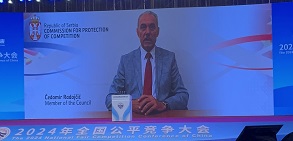 The State Administration for Market Regulation (SAMR) of the People’s Republic of China held a National Conference on Fair Competition in Wuhan, the capital of Hubei Province.
Council member of the Commission for Protection of Competition, Čedomir Radojčić, addressed the attendees via video message, emphasizing the importance of collaboration between the Commission and the State Administration for Market Regulation of the People’s Republic of China. The Commission for Protection of Competition and the State Administration for Market Regulation have signed a memorandum of cooperation and fostered a long-standing partnership that is vital for advancing competition protection internationally, harmonizing the legal framework, and improving economic cooperation between China and Serbia.
The conference was opened by Luo Wen, Minister of the State Administration for Market Regulation, who highlighted in his introductory speech that the primary goal of their institution is to accelerate the establishment of a unified national market, which will be driven by the comparative development of competition principles.
The conference in Wuhan featured participants that included officials from Chinese institutions, as well as experts from various competition authorities, such as representatives from Singapore, Hong Kong, Japan, Russia, Brazil, Italy, Spain, the United States, and others. Additionally, representatives from international organizations, including the OECD, the EU, and BRICS, were also present.
30.07.2024
The Commission for the Protection of Competition has prepared proposals for four new regulations concerning exemptions from the prohibition of agreements, and in particular:
- Proposal of the Regulation on categories of vertical agreements exempted from the prohibition of restrictive agreements;
- Proposal of the Regulation on categories of vertical agreements on repair and maintenance of motor vehicles and agreements on the sale of spare parts in the motor vehicle sector exempted from the prohibition of restrictive agreements; and
- Proposal of the Regulation on categories of technology transfer agreements exempted from the prohibition of restrictive agreements;
- Proposal of the Regulation on categories of agreements in the railway and road transport sector exempted from the prohibition of restrictive agreements.
In accordance with the provisions of the Law on the Planning System (“Official Gazette of the RS” 30/18), the Law on State Administration (“Official Gazette of the RS” 79/05, 101/07, 95/10, 99/14, 30/18, and 47/18), the Rules of Procedure of the Government (“Official Gazette of the RS,” nos. 61/06 – consolidated text, 69/08, 88/09, 33/10, 69/10, 20/11, 37/11, 30/13, 76/14, and 8/19 – other regulation), as well as relevant by-laws, consultations have been conducted in the process of preparing the proposals for the adoption of the aforementioned regulations.
The objective of conducting consultations was for the Commission to collect and assess pertinent information, viewpoints, remarks, and suggestions from various stakeholders, particularly legal entities and individuals whose positions, rights, obligations, and legal interests may be impacted by the proposed regulations.
The consultations were conducted through the eKonsultacije Portal and took place from July 4, 2024, to July 15, 2024. In the course of the consultation process, the Commission received proposals and comments concerning the draft regulation on categories of vertical agreements exempted from the prohibition of restrictive agreements, as well as the draft regulation pertaining to categories of vertical agreements for the repair and maintenance of motor vehicles, including agreements for the sale of spare parts in the motor vehicle sector that are exempt from the prohibition of restrictive agreements. As a result of amendments in the draft regulation on categories of vertical agreements exempted from the prohibition of restrictive agreements, adjustments were made concerning vertical agreements within the draft regulation on categories of technology transfer agreements exempted from the prohibition of restrictive agreements.
29.07.2024
 A meeting took place at the Commission for Protection of Competition involving representatives from the Ministry of Internal and Foreign Trade, the Republic Secretariat for Public Policies, the National Academy for Public Administration, and the Commission, within the framework of the IPA III project entitled “EU Support for the Development of Serbia’s Internal Market,” financed by resources from the European Union.
The focus of the meeting was on preparing training for civil servants engaged in the drafting of regulations, with the goal of improving their knowledge of competition rules and equipping them to create legislation that is either pro-competitive or neutral regarding market competition. The meeting was attended by competition expert Pablo Delgado Cubillo from the CNMC, the Spanish competition authority.
25.07.2024
On April 4, 2024, the Commission for the Protection of Competition initiated proceedings against “Društvo sa ograničenom odgovornošću za trgovinu električnim alatima Metabo centar Kragujevac” and KAPRO INDUSTRIES LTD from Israel, based on a reasonable assumption of a competition infringement through the conclusion of a restrictive agreement in accordance with Article 10 of the Law on the Protection of Competition.
The decision to initiate proceedings was delivered to the “Metabo Centar Kragujevac” company on April 4, 2024, when authorized officials from the Commission for the Protection of Competition also conducted a dawn raid at the company’s premises.
As KAPRO INDUSTRIES LTD from Israel, the second party in the proceedings, does not have a direct presence in the territory of the Republic of Serbia, nor an affiliated company, the decision to initiate proceedings was formally delivered on July 1, 2024, through official channels, specifically via diplomatic means, facilitated by the Embassy of the Republic of Serbia in Israel.
The proceedings were initiated based on information that “Metabo Centar Kragujevac”, as the importer of mechanical and laser measuring instruments produced by “Kapro,” through the manufacturer KAPRO INDUSTRIES LTD from Israel, has been exerting pressure on other foreign suppliers of “Kapro” tools, urging them to halt deliveries to other market participants in the Republic of Serbia. In the course of the investigation, a comparison of price lists from several market participants who imported tools of the aforementioned brand revealed that the prices of products in the price list of “Metabo Centar Kragujevac” were higher than the prices of identical products in the price lists of other observed market participants, who were being restricted from importing.
Based on the foregoing, the Commission has reasonably concluded that “Metabo Centar Kragujevac” and “Kapro” Israel are undertaking actions with the aim of, or resulting in, the elimination of competition for Metabo Center in the wholesale market for “Kapro” branded tools within the territory of the Republic of Serbia. Consequently, customers purchasing these tools are incurring higher costs than they would if additional distributors were permitted to operate in the market.
It was further established that the contracts concluded by “Metabo Centar Kragujevac” with its customers include a prohibition on selling below the purchase price, which may serve as a supporting mechanism for the import ban to maintain the prices of “Kapro” branded tools at a desired level. This practice also constitutes an infringement of competition in the form of establishing minimum resale prices.
All individuals possessing data, documents, or other relevant information that may be pertinent to establishing the factual circumstances in the aforementioned proceedings are kindly invited to submit such information to the Commission for Protection of Competition, located at 25 Savska Street, Belgrade.
23.07.2024
The Commission for Protection of Competition has, ex officio, initiated proceedings against the company VILLAGER, trgovina na debelo, d.o.o, Ljubljana, Republic of Slovenia, to investigate a concentration that was executed without approval in accordance with the Law on Protection of Competition. It is reasonably presumed that this concentration arose from VILLAGER, d.o.o. acquiring control over SEMENARNA Ljubljana, a production and trading company, d.o.o., located in Ljubljana, Republic of Slovenia.
The Commission will evaluate the criteria prescribed by law (Article 19 of the Law on Protection of Competition) during the investigative proceedings to determine the permissibility of the concentration. In particular, it will consider the fact that this concentration was executed without notification, which constituted an obligation for the market participants. The law provides that concentrations among market participants are permissible, except where they would significantly restrict, distort, prevent competition in the market of the Republic of Serbia. This is particularly relevant if that restriction, distortion or prevention is the result of creating or strengthening of a dominant position.
The Commission will ascertain the essential facts, evidence, and other elements that will serve as the basis for its decision regarding the potential imposition of competition protection measures, specifically measures of deconcentration.
Through the conclusion initiating the proceedings, all individuals possessing data, documents, or other relevant information that may be pertinent to establishing the factual circumstances in the aforementioned proceedings are kindly invited to submit such information to the Commission for Protection of Competition, located at 25 Savska Street, Belgrade.
23.07.2024
The Commission for Protection of Competition has, ex officio, initiated proceedings against the company DRUŠTVO ZA PROIZVODNjU PROMET I USLUGE AGROMARKET DOO KRAGUJEVAC, based in Kragujevac, to investigate a concentration that was carried out without the necessary approval in accordance with the Law on Protection of Competition. It is reasonably presumed that this concentration resulted from AGROMARKET DOO acquiring control over AM Hotel, a specialized real estate company located in Ljubljana, Republic of Slovenia.
The Commission will assess the criteria established by law (Article 19 of the Law on Protection of Competition) during the investigative proceedings to determine the legality of the concentration. In particular, it will take into account that this concentration was executed without notification, which constituted an obligation for the market participants. The law stipulates that concentrations among market participants are permitted, unless they significantly restrict, distort, or prevent competition in the market of the Republic of Serbia, particularly if such restriction, distortion, or prevention is the result of creating or strengthening of a dominant position.
The Commission will ascertain the critical facts, evidence, and other elements that will serve as the basis for its decision regarding the possible implementation of competition protection measures, specifically measures aimed at deconcentration.
Through the conclusion that initiates the proceedings, all individuals in possession of data, documents, or other relevant information that may aid in establishing the accurate factual situation in this case are hereby invited to promptly submit such information to the Commission for Protection of Competition at the address: 25/IV Savska Street, Belgrade.
09.07.2024
End of February and throughout March, the Commission for the Protection of Competition, based on publicly available information, became informed of the intention of all three mobile operators to raise the prices of mobile telephony services. In relation to this issue, the Commission has received several initiatives requesting an investigation into the potential existence of a competition infringement. Acting upon these initiatives, the Commission gathered and analyzed the regulatory framework, publicly available data, and requested statements from all three mobile telephony operators in the Republic of Serbia.
Upon analyzing the regulatory framework, the Commission established that, pursuant to Article 87 of the Consumer Protection Law and Article 131 of the Electronic Communications Law, there is an obligation to notify, in advance, mobile telephony service users, among others, of any price changes. Based on publicly available information, it was confirmed that all three mobile operators had announced price increases for their services in advance, including public notification methods, 30 days prior to the price changes. As per the statements submitted by the operators in response to the Commission’s request, prior to announcing the price increases, certain operators consulted with the National Consumer Organization of Serbia or informed the Regulatory Authority for Electronic Communications and Postal Services in advance, through official correspondence, of the planned price increases. The Commission notes that it did not evaluate whether the notification to mobile telephony service users was in accordance with the aforementioned regulations, nor whether such a method of notification was adequate; rather, the notifications were assessed solely from the perspective of enhancing transparency in the market.
In the theory of competition protection, it is well recognized that markets characterized by classic oligopolistic market structures, such as the mobile telephony market in the Republic of Serbia, are particularly conducive to the alignment of behavior among competitors. In this regard, the Commission specifically analyzed data regarding the timing of the price increase announcements and the amount of the increases, particularly considering media reports related to similarities concerning these two factors, as well as the behavior of mobile operators during previous price increases for the same service.
Concerning the timing of the price change announcements, as previously stated, all three operators complied with regulatory requirements by notifying customers of the price changes for mobile telephony services 30 days in advance. Based on the data provided by all three mobile telephony operators at the Commission’s request (including the sequence of price increase announcements, documentation published in this context, etc.), there were no reasonable grounds to assume the existence of a prior agreement regarding the price increases.
Regarding the amount of the price increases, it was also determined that there are no reasonable grounds to assume the existence of a prior agreement concerning this pricing element. Specifically, an analysis of the data submitted at the Commission’s request regarding price increases among all three operators—both for individual packages that are comparable and for the average values of the increases—revealed that the price increases are not equivalent, either in nominal terms or as a percentage, across the three mobile telephony operators under consideration.
Additionally, the Commission analyzed previous behaviors to ascertain whether there was any discernible pattern in the actions of mobile operators during earlier price increases for the same service. However, based on the available data, no such pattern was identified.
In the light of the factors previously outlined, as well as the fact that the operators publicly announced and published their price increases 30 days prior to the implementation of the new prices to ensure compliance with the Consumer Protection Law and the Electronic Communications Law, and noting that such notification methods were not observed during prior price increases for mobile telephony services, coupled with the absence of any behavior suggestive of prior collusion, it has been determined that, based on the collected evidence, no conclusions can be drawn regarding the existence of direct or indirect secret agreements.
Thus, in highly concentrated markets, a price change that is not associated with any prior agreement, and which is neither simultaneous nor equal in nominal or percentage terms, and has been communicated in advance to consumer organizations, the regulatory authority, and publicly disclosed in accordance with relevant regulations, is inadequate for the Commission to reliably infer behavior that would suggest a violation of competition law. This falls short of the legal standard required for the ex officio initiation of proceedings—specifically, the existence of reasonable grounds under Article 35 of the Law indicating that a competition infringement has occurred.