


 President of the Commission for Protection of Competition, Miloje Obradović, PhD, received a visit from the World Bank Country Manager for Serbia, Tony Verheijen.
Dr Obradović presented to Mr. Verheijen activities implemented so far, in addition to the Commission’s plans aimed at the improvement of competition policy in our country. During the meeting, the Commission President specifically emphasized the importance of permanent education in the area of competition policy legislation of all institutions and levels of government, and in particular the judicial authorities.
World Bank Country Manager for Serbia pointed out that this international institution participates in the judicial reform project in the Republic of Serbia, during which they have received a numerous private sector complaints relating to the functioning of the courts in our country, in particular the administrative and commercial courts.
To that end, the joint interest to cooperate with all competent authorities and institutions is identified in order to improve the functioning of the judiciary in Serbia. Also, it has been concluded that both institutions hold an important role in enhancing the competitiveness of our country and in the process of restructuring state owned enterprises and public utility companies.
It has been agreed that communication between the Commission for Protection of Competition and the World Bank Country Office in Serbia will be intensified in the period to come, with the objective of improving the economic environment of our country.
The meeting was also attended by Srđan Svirčev, WB Public Sector Expert, Marko Obradović, member of the Council of the Commission for Protection of Competition, and Nina Vasić, Advisor in the Department for Domestic and International Cooperation of the Commission.
 President of the Commission for Protection of Competition, Miloje Obradović, PhD, met with Ms. Radica Nusdorfer, newly appointed Head of the Economic and European Integration Section at the EU Delegation to Serbia.
Current issues related to competition policy and Commission’s activities within the EU accession process were discussed during the meeting, having in mind the significance of competition policy in the EU legal and institutional framework.
President Obradović also introduced Ms. Nusdorfer to preparations for improving competition related regulatory framework in Serbia, in addition to the profile-raising activities of competition policy implemented by this institution.
Head of the Economic and European Integration Section at the EU Delegation to Serbia, Ms. Radica Nusdorfer, commended activities of the Commission implemented up to present and proposed more intense cooperation with the EU Delegation to Serbia in the context of our country’s competition policy improvement endeavors.
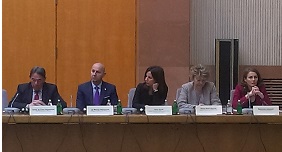 President of the Commission for Protection of Competition, Miloje Obradović, PhD, following the invitation of the Anti-Corruption Agency, participated at the conference “Cooperation of the Anti-Corruption Agency with state institutions in the fight against corruption”.
Considering that the Commission for Protection of Competition has signed agreements with numerous state institutions and more intensely cooperates with the Anti-Corruption Agency as well, the latter being confirmed by the Agreement these two institutions have signed together with the Republic Commission for Protection of Rights in Public Procurement Procedures, this event provided the appropriate opportunity for presenting activities that the Commission for Protection of Competition, in line with its legal competences, conducts on a daily basis.
President of the Commission, dr Miloje Obradović, reminded participants of the conference that the Law on Protection of Competition belongs to the group of systematic anti-corruption legislations. “One of the preconditions for increasingly efficient work of the Commission is a constant dialogue and qualitative system of information exchange with the competent authorities in the Republic of Serbia”, dr Obradović emphasized during the symposium, and as an example of successful cooperation specifically pointed to the recently signed agreement with the Anti-Corruption Agency and Republic Commission for Protection of Rights in Public Procurement Procedures. “The objective of this agreement is protection of public interest, reduction of corruption related risks and strengthen institutional integrity”, specified dr Obradović.
Director of the Anti-Corruption Agency, Tatjana Babić, emphasized that the fight against corruption is a joint endeavor of all institutions.
“No single anti-corruption institution is able to achieve much if it doesn’t have the police and courts on its side and if is ill-financed”, said Director Babić. She added that in the fight against corruption is necessary to have a „neverending patience“, as well as to invest enormous efforts in making baby-steps.
Objective of the conference was to highlight the commitment and cooperation achieved so far of all state institutions in the fight against corruption.
Deputy Prime Minister and Minister of Interior, Nebojša Stefanović, PhD, President of the State Audit Institution, Radoslav Sretenović, Dean of the University of Belgrade’s Law School, professor dr Sima Avramović, and directors of the Tax Administration and Public Procurement Office participated in the conference, and other representatives from international organizations, civil society and the media.
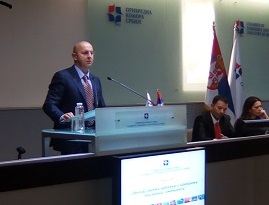 President of the Commission for Protection of Competition, Miloje Obradović, PhD, delivered a keynote address during the opening part of the expert symposium “Significance of public procurement in creating business environment”.
Addressing the competences of the Commission in this segment of business activities, President Obradović reminded that pursuant to the Law on Protection of Competition, rigged bids in public procurement are considered as the most severe competition infringements.
Dr Obradović emphasized, among other things, that detected rigged public bids are sanctioned in accordance with the Law in monetary terms in the amount up to 10% of total preceding year revenues, in addition to the prohibition against participating in public procurement procedures during certain period of time. Dr Obradović ascertained that sometimes „appears that this is not a sufficient threat to those who believe that their personal financial interests are above the prosperity of society they are part of“.
During last year, the Commission published the Opinion on the implementation of Article 10 of the Law on Protection of Competition, thus defining the position of the Commission in the case of affiliated undertakings in public procurement procedures. The intent of the Commission during drafting of this document, as dr Obradović also specified, was to secure achievement of a higher degree of legal security of all undertakings in public procurement procedures, increased transparency of the Commission’s operations and more efficient implementation of the Law on Protection of Competition, as well as of the Public Procurement Law.
In the second part of the symposium, the Commission representative, Vladimir Antonijević, presented the role of the Commission for Protection of Competition in public procurement procedures.
The symposium was organized by the Chamber of Commerce and Industry of Serbia in cooperation with the Commission for Protection of Competition, Public Procurement Office and Republic Commission for Protection of Rights in Public Procurement Procedures.
 The Commission for Protection of Competition expresses its concern due to the City of Subotica Assembly failure to fully act on the Commission opinion relating disputed provisions of the decision arranging utility service of burial and cemetery management in Subotica.
The Commission’s position, presented in the opinion, is that competition infringement and awarding monopoly rights to the municipal public utility company to the detriment of the service users must not occur. The Commission does not believe that granting monopoly rights based on the interpretation of legal terms “burial” and “other acts” is admissible, as considered by the City of Subotica Assembly.
The Commission has sent opinions to the City of Novi Sad Assembly and City of Pančevo Assembly regarding similar issue, whereas the Commission’s position has been acknowledged and fully implemented.
The Commission points that they continue to believe that the City of Subotica Assembly interpretation is too wide, which as its consequence has a restriction of competition and creation of monopoly in conducting burial and cemetery management utility service, when such behavior is neither necessary nor preferable. In that sense, it is expected that disputed provisions of the decision arranging utility service of burial and cemetery management by the City of Subotica Assembly shall be immediately amended pursuant to the opinion provided by the Commission.
On that account, the Commission also sent an opinion to the line ministry pointing to the need to precisely define terms arranging the area of burial and cemetery management in the future regulations so that monopolization of those activities based on different interpretations of legal provisions would be avoided.
The Commission takes this opportunity to emphasize the significance of treatment of the City of Subotica Assembly, considering that by adopting amendments to the disputed decision it would achieve a positive influence on competition. Amendments to the disputed provisions would enable conducting certain funeral services by all interested parties, that is, not just the public utility company but also other companies, entrepreneurs and other business entities, to the benefit of all service users.
 President of the Commission, Miloje Obradović, PhD, spoke at the ordinary meeting of the Subcommittee on Internal Market and Competition held in Brussels.
Dr Obradović introduced the European Commission representatives on all activities related to the implementation of the Law on Protection of Competition, as well as on the degree of harmonization of competition related regulations with the EU acquis, which is in accordance with the commitments from Article 73 of the Stabilization and Association Agreement.
In presenting the Commission’s operative results, President Obradović emphasized that the commitment related to harmonization of the Law on Protection of Competition against the new Law on General Administrative Procedure shall represent a great challenge, but that for competition policy implementation is of a great significance that proceedings conducted before the Commission be recognized and defined as a separate administrative procedure, adjusted to the needs of the Law on Protection of Competition.
In its addressing, the Commission President pointed that the institution he heads, and in line with the possibilities and competences, shall endeavor to contribute in creating projects that would bring the subject of competition legislation closer to the judges, aimed at enabling advanced training for working on the cases from this area, which would also have an impact on achieving more efficient implementation of the Law on Protection of Competition.
In its addressing, President Obradović particularly mentioned: “The focus of sector inquiries shall be directed towards markets that in previous period already provoked the interest of the Commission as the case proceedings, or that based on the information are pointing to the fact that the current competition conditions may cause a concern of the Commission. Plausible sectors we shall investigate in the period to come, might encompass the gas, retail and pharmaceutical products markets.”
It has also been highlighted that the Commission’s intent, within its activities, is to promote the Leniency program even more intensely, and to introduce undertakings to the related advantages.
“The Commission shall also continue to work more intensely on raising awareness of the necessity to protect competition in Serbia, as well as on the implementation of practice related to including all interested parties in the regulations drafting procedure, aimed at securing transparency in the Commission’s operations”, said Dr Miloje Obradović, Commission President, in closing to its speech.
During the Subcommittee meeting that is regularly held as part of Serbia’s EU accession process, is presented that our country follows the dynamics of competition development in the EU and strives as much as possible to harmonize its standards against the EU standards. This is also confirmed by the EC review given in recently published the Progress Report for 2016, in which is emphasized that Serbia’s legal framework is mostly aligned with the EU acquis.
 The Commission for Protection of Competition intends to conduct the retail market competition inquiry related to non-specialized stores predominately supplied with food, beverages and tobacco. The inquiry would encompass the retail end-user and procurement markets, focusing on the relationship between retailers and their suppliers.
The sector inquiry related to this market is important having in mind that retail sales represent the sector where, perhaps predominately, the significance on the consumers is conspicuous, therefore making it considerably important to perform an overview of tendencies in this industry, as well as in related sectors within the supply chain.
In addition to the aforementioned, the considerable enlargements on the retail market and distribution of foodstuff have occurred during the last decade in Serbia, which reflected on the commercial relations between retailers and their suppliers, as well as on the considerable market concentration.
Having in mind these facts, the Commission concluded that the situation on retail market in the Republic of Serbia points to the need to conduct the inquiry on competition conditions and alterations in the market structure, as well as the inquiry on this specific undertakings’ behavior that might represent a competition infringement.
The results of this inquiry would also enable the Commission to conduct ex-post inquiries on more significant concentrations implemented in the previous period.
The inquiry should also contribute to the improved perception of contractual relations between suppliers and market chains, along with the effects those relations may have on the condition of competition on the market, foremost keeping in mind the relative small number of initiatives for instituting competition infringement procedures submitted in the previous period.
 On November 28, 2016, the Foreign Investors Council in Serbia presented this year’s edition of the “White Book”, a traditional overview of the business climate in Serbia, as well as recommendations for its improvement.
This document states a significant improvement achieved in operations of the Commission for Protection of Competition of the Republic of Serbia.
As per evaluation of the Foreign Investors Council, “the progress in the field of protection of competition was propelled by continuous regulatory improvements, strengthening of administrative capacity, and strong advocacy activity by the Commission for Protection of Competition. The key positive developments include the following activities performed by the Commission: successful implementation of the binding procedure; enacting the new Regulation on notification of concentration – merger control (in accordance with the EU legislation); readiness to organize pre-notification meetings in order to eliminate any ambiguities; more frequent conduct of down raids; stronger advocacy activities related to the development of competition policy by providing more information on its work, publishing opinions and decisions on the website and other promotional activities.”
The recommendation provided to the Commission is to provide a monthly overview of its activities and not only within its Annual Reports, because it would definitely contribute to increasing transparency in the work of the Commission.
The “White Book” is an overview of the business climate in Serbia provided from the angle of foreign investors, and at the same time and in transparent manner serve as a platform for communication with the authorities, and in this sense also contain certain recommendations for improvement of the state authorities operations.
 Representatives of the Department for Economic Inquiries of the Commission for Protection of Competition, Siniša Milošević, PhD, Department Head, and Jelena Markopoulos, MA, Senior Advisor, attended the 14th annual conference of the Association of Competition Economics – ACE, held in Amsterdam.
The two-day conference is organized into three plenary sessions and multiple parallel sessions, during which the numerous current cases from the European competition authorities’ practice were discussed, from concentrations (Celesio/Sainsbury, Ahold/Delhaize, British Telecom/EE, etc.), abuse of a dominant position (Deutsche Post), and harmonized practice (Container Shipping), to the energy market inquiries conducted in Great Britain.
During the stay in the Netherlands, the Commission representatives also attended the conference organized by the Netherlands Authority for Consumers and Markets – ACM, honoring the tenth year operating anniversary of the Department for Economic Inquiries.
Numerous representatives of the European competition authorities, reputable consulting firms and academics attended the conference, exchanging their experiences regarding the review of competition and consumer protection authorities’ operating efficiency.
 On November 14, 2016, the President of the Commission for Protection of Competition enacted the Conclusion on continuation of proceeding ex officio, instituted upon the Notification of concentration submitted by the „Serbia Broadband – Srpske kablovske mreže” Ltd company, created by acquiring the control over the „Interaktivne kablovske objedinjene mreže – I.KOM” Ltd company. The proceeding is continued ex officio for investigation of the notified concentration’s fulfillment of conditions of permissibility from Article 19 of the Law, i.e. determining whether the implementation of such concentration would significantly restrict, distort or prevent competition in the market of the Republic of Serbia or its part, and in particular if such restriction, distortion, or prevention would be the result of creating or strengthening of a dominant position.
During the investigation proceeding, the Commission shall conduct all necessary actions and determine all facts and present evidence necessary for defining the relevant market(s), structure of the relevant market(s), degree of concentration of the relevant market(s), identification of actual and potential competing parties, concentration participants’ market position, suppliers and users’ possibility to choose, legal and other obstacles for entering the relevant markets, competitiveness level of the concentration parties, users’ interests, etc.
In accordance with the Law, the Commission is obligated to complete the proceedings within the period of four months from the date of instituting proceeding ex officio.
All persons in possession of data, documentation or other relevant information that could contribute to the accurate fact-finding in this proceeding are called upon to immediately submit the said to the Commission for Protection of Competition, 25/IV, Savska Street, Belgrade.